

Bitfinex Alpha | BTC Settles…For Now
Bitcoin’s slide to the $60,000 handle marks the deepest drawdown of the current cycle, with losses now exceeding 52 percent from the October 2025 all-time high and January registering its weakest performance since 2022. The market has decisively lost multiple structural supports, including the short-term holder cost basis, the yearly open, and the True Market Mean, confirming a regime shift from distribution into a sustained downtrend. Unlike prior liquidation-driven sell-offs, the latest leg lower was characterised by persistent, price-agnostic spot selling, culminating in the largest single-day market cap decline in Bitcoin’s history and briefly pushing price to $60,100 before a sharp reflexive bounce.
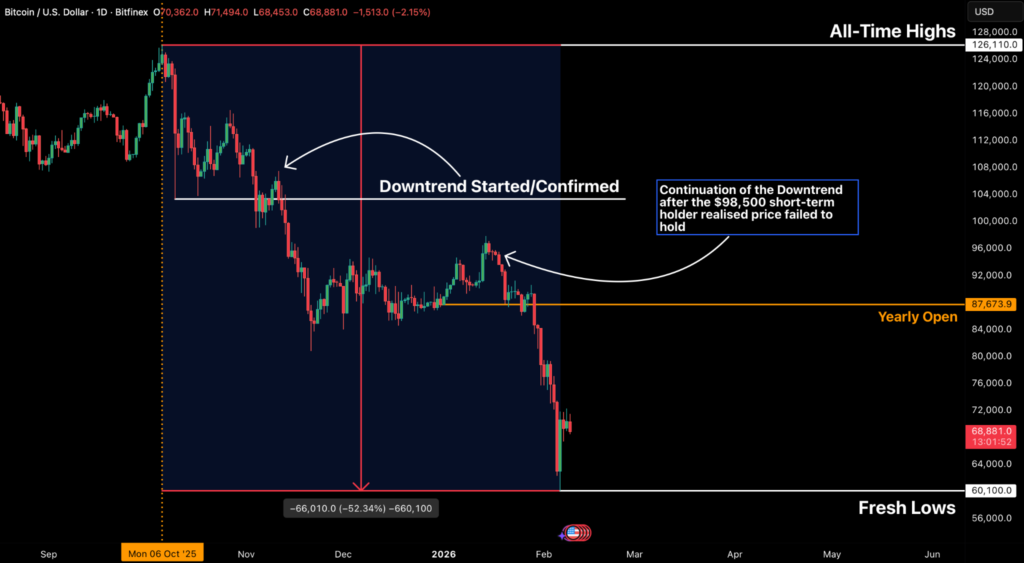
On-chain stress indicators underline the severity of the move but also hint at emerging exhaustion. Realised losses have surged above $1.2 billion per day, levels historically associated with late-stage corrective phases rather than trend initiation. At the same time, leverage has been materially flushed, with global open interest down nearly 50 percent from the peak, reducing systemic fragility. While seasonality has failed and near-term momentum remains bearish, the confluence of capitulation signals suggests Bitcoin is entering a stabilisation phase. The $60,000–$74,000 zone now defines the key battleground, with the market likely to consolidate here as it digests losses and resets positioning, ahead of clearer signals on whether this range becomes a base for recovery or a pause before further downside.
Recent US data suggests the economy is stabilising unevenly rather than entering a renewed expansion. Household confidence has edged modestly higher, but sentiment remains fragile and uneven, with gains largely concentrated among households with equity exposure. At the same time, consumer credit growth has accelerated well beyond expectations, indicating that spending is increasingly supported by borrowing rather than improving income prospects. This points to short-term resilience built on financial accommodation, not a durable improvement in household fundamentals.
Labour market data reinforces this cautious picture. Layoffs have risen sharply, job openings have fallen to multi-year lows, and hiring momentum has slowed materially, even as the unemployment rate remains historically low. Market-sensitive indicators have responded quickly, with short-term Treasury yields declining as expectations for policy easing later in the year increase. While artificial intelligence features prominently in corporate layoff narratives, current evidence suggests restructuring and softer demand — rather than automation — remain the primary drivers of job losses.
Bond market signals align with this shift. The US Treasury yield curve has moved back into positive territory after a prolonged inversion, reflecting easing pressure on short-term rates rather than stronger growth expectations. Investors appear increasingly focused on slowing labour momentum and future policy relief, while households and firms continue to respond to present constraints. This divergence is also evident in the housing market, where activity remains subdued despite easing mortgage rates, as buyers remain cautious amid high prices and income uncertainty. Rising listings suggest a gradual rebalancing rather than a rapid recovery.
Against both this macro backdrop, and the recent market dislocation in digital assets, the People’s Bank of China has reaffirmed its restrictive stance by extending bans to real-world asset tokenisation and yuan-linked stablecoins. Meanwhile, South Korea’s financial regulator is stepping up cryptocurrency oversight with targeted investigations and tougher enforcement to curb market manipulation, address operational risks at exchanges, and strengthen customer protection.
Overall, the combined data points to an economy adjusting late in the cycle, where financial markets are pricing future easing, households remain cautious, and digital asset growth is increasingly shaped by balance-sheet strength and regulatory alignment rather than broad-based risk appetite.