

Issue #221:
Payrolls Put a Hike in Play, Bitcoin Holds the Range
Bitcoin Holds $80,000 as Strong Payrolls Push September Hike Odds to 60 Percent
August payrolls have pushed the odds of a 16 September rate rise to 60 percent, yet bitcoin is holding near $80,000 and spot ETFs took in $986.7 million on the week. Employment and manufacturing data have reduced concerns about an abrupt slowdown, but persistent price pressures have shifted the policy debate towards inflation. BTC has responded by holding its recovery near $80,000 rather than extending it. The next test is whether incoming inflation data and Treasury market conditions allow the market to move beyond consolidation.
The August employment report strengthened the case for a 25 basis-point increase in rates. Nonfarm payrolls rose by 162,000, unemployment remained at 4.1 percent and revisions to earlier months improved the picture of recent hiring. Manufacturing also continued to expand, with the Purchasing Managers’ Index at 54.6, although elevated input costs remain a concern. Markets raised the implied probability of a September increase to around 60 percent. The Producer Price Index and Consumer Price Index reports on 10 and 11 September will now determine whether inflation is easing enough to justify a hold.
Treasury markets show that monetary policy is only part of the pressure on financial conditions. The two-year yield rose to 4.37 percent as investors repriced the Federal Reserve outlook, while the 30-year yield remained elevated at 5.24 percent. The long end continues to reflect concerns about fiscal deficits and the supply of government debt. The enlarged Treasury buyback scheduled for 9 September is the first test of whether liquidity support can contain that pressure.
A renewed rise in long-term yields would increase borrowing costs and could weigh on risk assets, even if the Fed’s policy path becomes clearer.
Bitcoin has so far absorbed these headwinds without losing its market structure. BTC reached $82,320 on 3 September before returning to its established $77,200-$82,100 range. Flows into US spot bitcoin Exchange Traded Funds (ETFs) were solid last week, while stablecoin supply continued to expand. These flows indicate that demand remains present, but higher short-term yields put a limit on price follow-through. Liquidity is putting a floor under the price, and the short end of the Treasury curve is setting the ceiling. The recovery also faces a larger pool of profitable supply than at comparable price levels in May, increasing the potential for selling near previous highs.
Our view on BTC remains constructive, but the conditions for a sustained advance have not yet been met. Continued ETF inflows and stablecoin growth are providing support, while the Fed outlook and elevated Treasury yields remain constraints. A soft set of inflation reports this week could reopen the case for a September hold, but evidence of persistent inflation would reinforce the case for a rate increase. The clearest sign of improving market strength would be a sustained break above the current range while capital inflows remain positive and rate expectations stay elevated. Until then, the evidence supports continued consolidation with an upside bias, rather than a confirmed breakout.

Market Signals
A 42 Percent Rebound From July Lows Survives Perceived Hawkish Fed
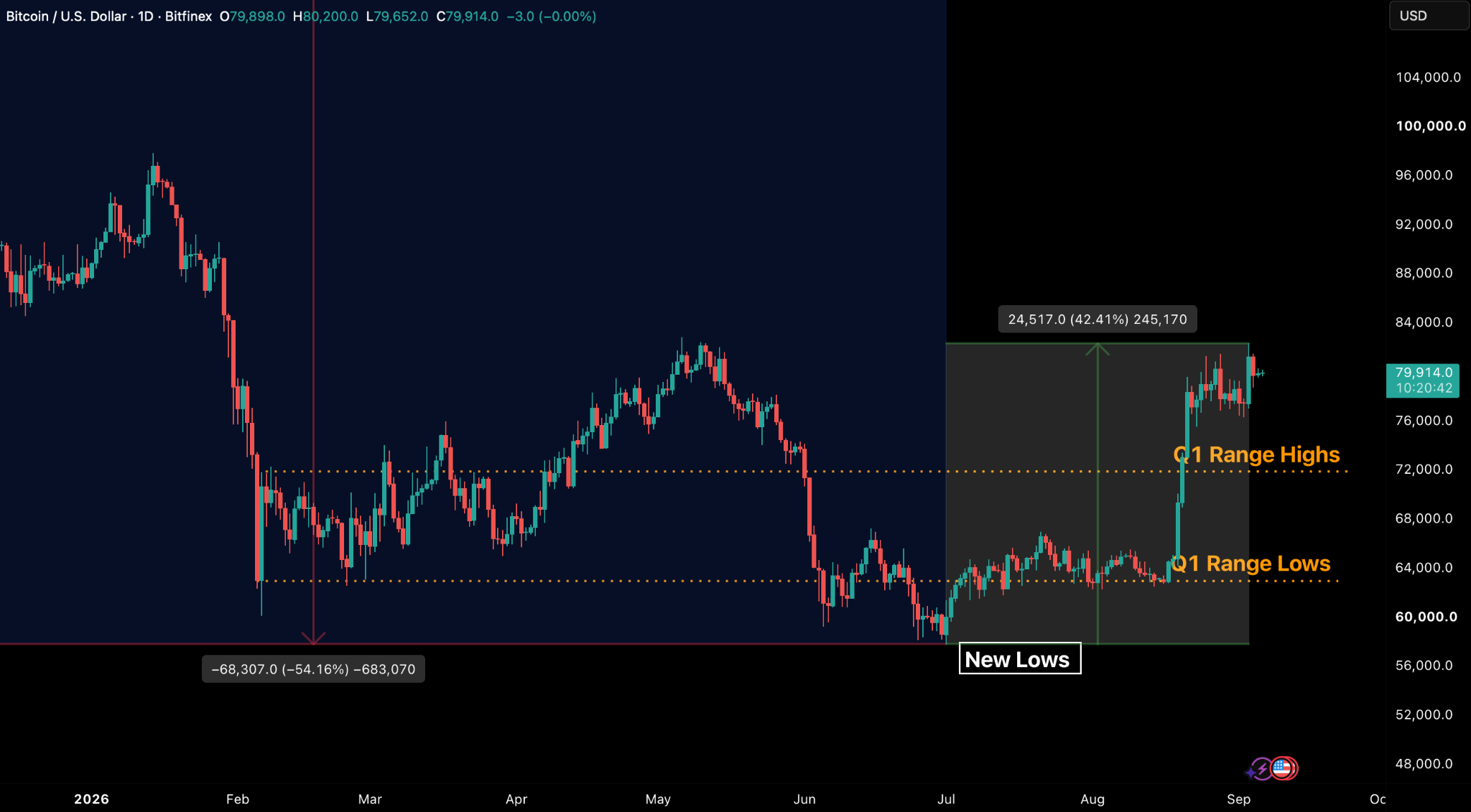
Bitcoin continued to trade in its new range above the True Market Mean, which currently sits at $76,500. Price set a new local high last week, reaching $82,320 on Thursday, 3 September, its highest in 118 trading days. The move also represents a 42.4 percent recovery from the bear market lows of early July, which marked a 54.2 percent correction from the late 2025 all-time high. Equities and crypto have both absorbed the macro headwinds behind rising odds of a rate increase. BTC has consolidated in a defined range between the two high-volume nodes outlined in last week’s Alpha at $77,200 and $82,100.
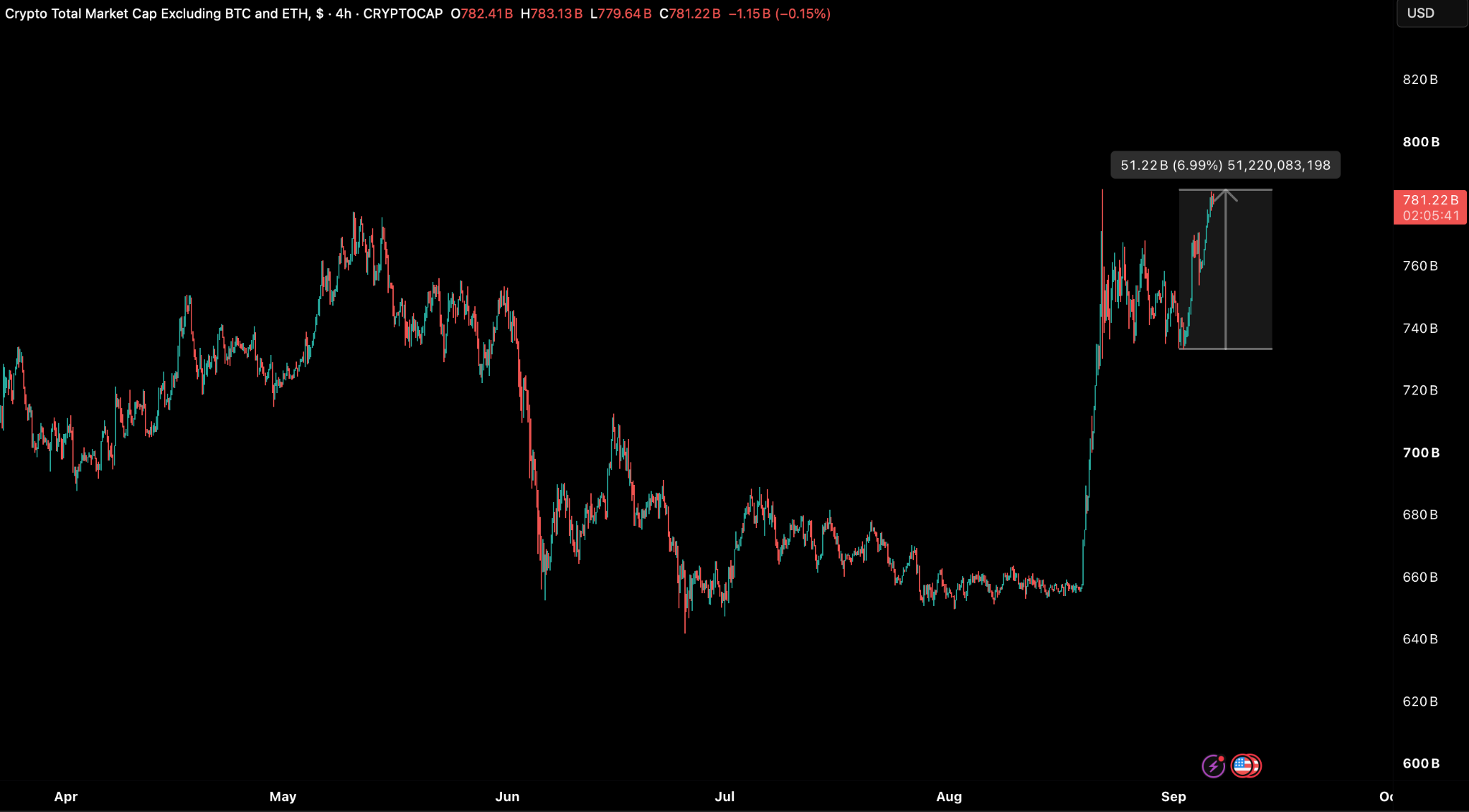
Short pauses in price appreciation are common when a mid-timeframe uptrend is set to continue. The market is now waiting for a catalyst to carry price higher. Our view remains that momentum favours the upside, despite some supply overhang and potential macroeconomic headwinds. With just over a week having passed since the Fed Chairman’s hawkish Jackson Hole speech, BTC has been successfully stress-tested. Price fluctuated within a broad corridor from $77,200 and $82,100, moving from the range floor on Wednesday 2 September to the ceiling on Thursday 3 September, topping out at $82,320. Select altcoins have continued to outperform, while BTC has held its structure without a daily close beyond these key levels. TOTAL3, the index measuring total crypto market capitalisation excluding stablecoins, bitcoin and ether, has increased by $51.2 billion since the beginning of September. The index has now broken past its mid-August levels.
One subtle point of friction for the current recovery, however, remains the shifting profile of supply profitability. During the May consolidation, when price reached above $82,500, approximately 67 percent of total supply was held in profit. At the same levels today, profitable supply stands above 71 percent.
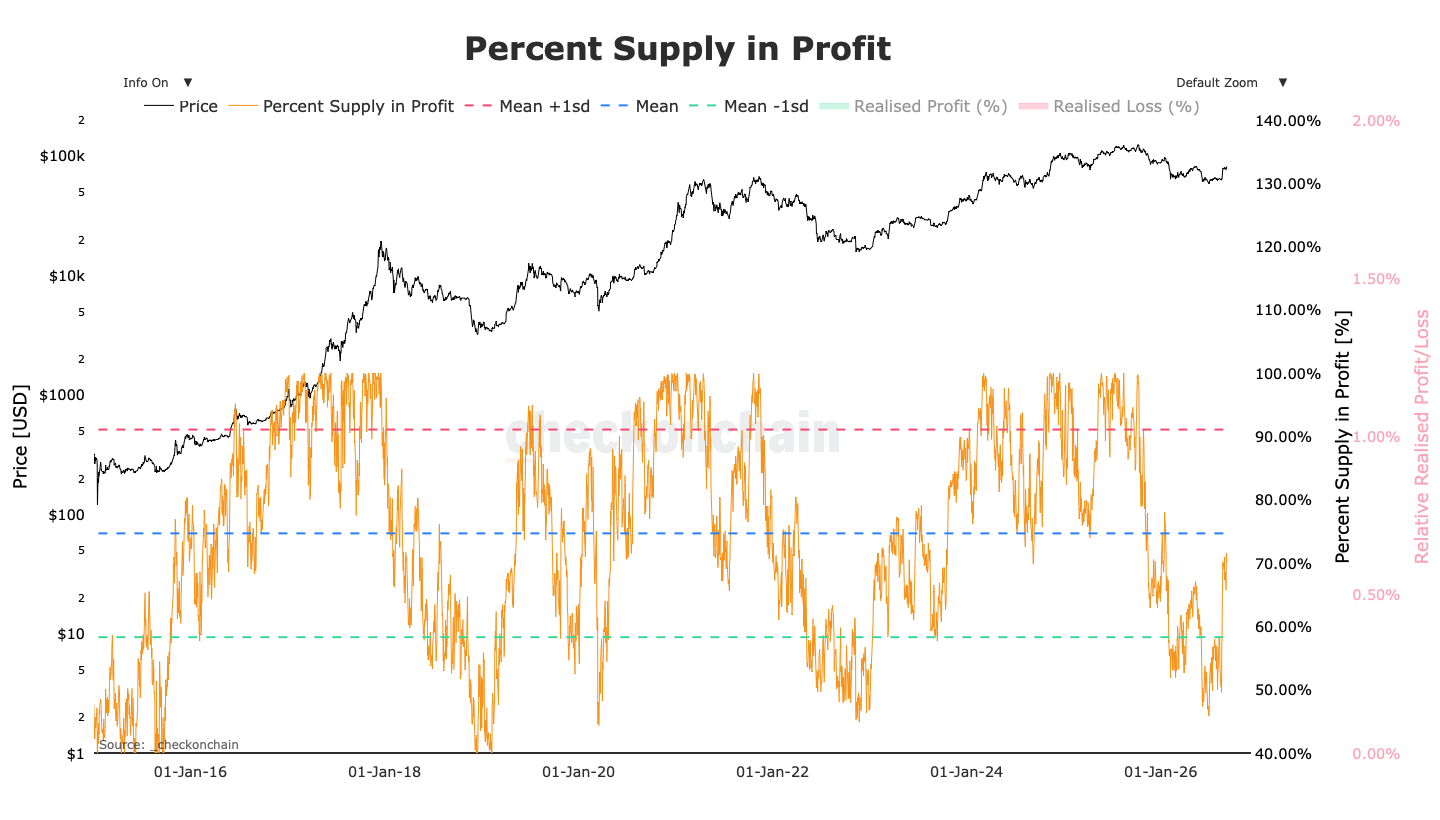
This trend underscores the impact of summer accumulation, which reset the Short-Term Holder Cost Basis to $68,400 at its lowest point. Identical nominal price levels now trigger a greater volume of profitable coins, establishing a deeper pool of latent sell-side liquidity whenever the market tests previous local highs. Supply in profit is also approaching its historical mean of 74.7 percent. A move above that mean has typically marked the transition from bear to bull markets.

General Macro Update
Labour and Manufacturing Data Strengthen the Case for a September Hike
The August jobs report, which reported unemployment holding at 4.1 percent and nonfarm payrolls up 162,000 for the month, increased the likelihood of a rate rise at this month’s Federal Open Market Committee meeting.
Markets moved the implied probability of a 25 basis-point increase at the 16 September meeting to 60 percent. Two-year Treasury yields ended the week even higher than after the Fed chairman Kevin Warsh’s hawkish speech at Jackson Hole just over a week ago.
US labour and manufacturing data point to an economy that is still expanding, with factory activity extending its recovery. The two data points reduce concern about an abrupt labour slowdown and shift more attention towards persistent price pressures as the Fed prepares for its September policy meeting.
The Labour Market Cooled Without Breaking the Economy
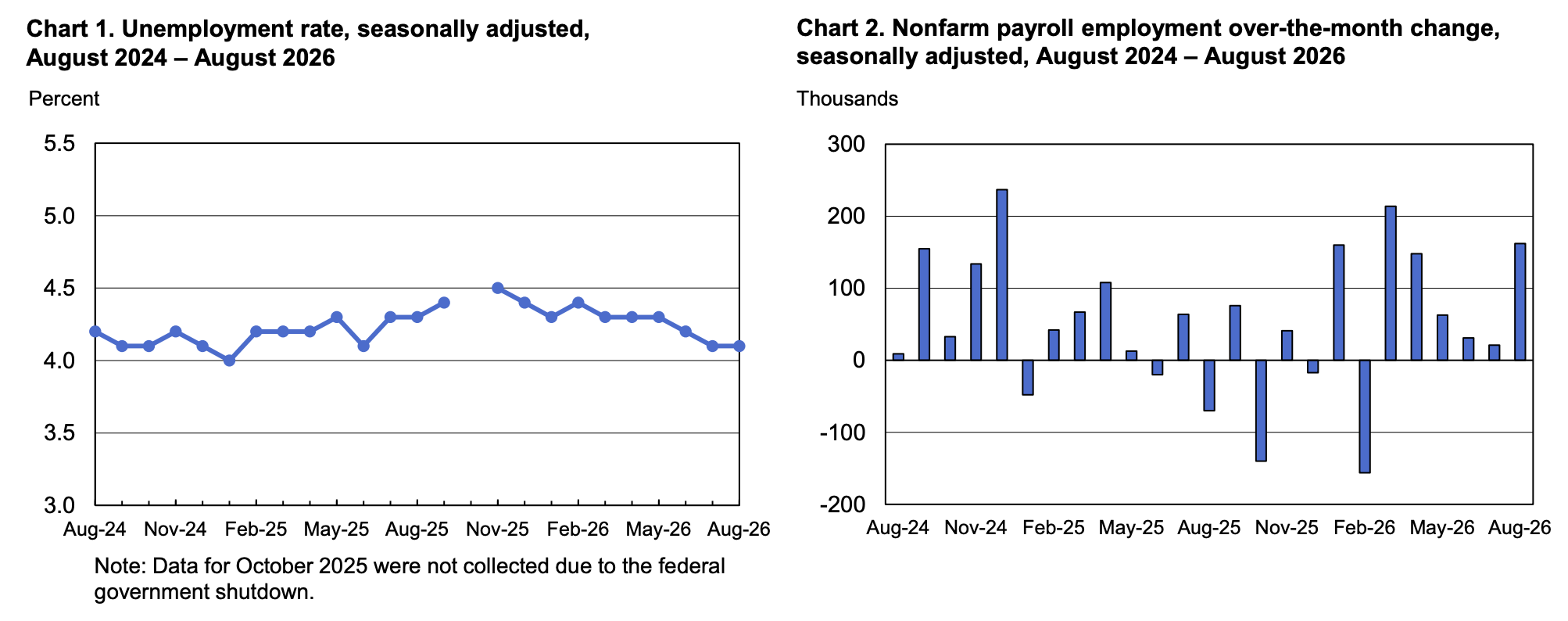
The Employment Situation report for August 2026, released by the US Bureau of Labor Statistics (BLS) on 4 September 2026, showed that the labour force increased by 683,000 people, while the participation rate rose to 61.6 percent. These figures suggest that more people entered the workforce without causing a material increase in unemployment.
The headline gain was also stronger when viewed alongside revisions to earlier data. The BLS revised June payroll growth from 20,000 to 31,000, and July from a decline of 23,000 to an increase of 21,000. The BLS revises the two most recent months as late survey responses from businesses and government agencies arrive and as seasonal adjustment factors are recalculated, so the first print is rarely the last.
The revisions added 55,000 jobs to the previous estimates of job growth and lifted the three-month average to about 71,000 jobs per month. That pace remains modest compared with stronger periods of recent employment growth, but it does not point to a labour market in distress.
The data is consistent with an economy operating close to full employment. With unemployment at 4.1 percent and more people joining the workforce, the Fed has less reason to use lower interest rates to support hiring.
Job Growth Remains Uneven Across Industries
The composition of August hiring showed strength in both services and goods-producing industries, with weakness concentrated in a smaller group of sectors. Information employment fell by 23,000, while financial activities lost 11,000 positions. Information companies cut jobs in areas including data processing, web hosting, publishing and broadcasting. These industries have significant exposure to technological change, including artificial intelligence (AI), but the employment data alone cannot establish that AI caused the reductions.
Wage and working-hour data also suggest that household income remains supported. Average hourly earnings increased by 0.3 percent in August to $37.75 and by 3.1 percent from one year earlier. The average private-sector working week rose to 34.4 hours, while aggregate weekly hours increased by 0.3 percent during the month. Longer working hours combined with continued job creation can support consumer spending, although slower annual wage growth of 3.1 percent, down from 3.2 percent in July and 4 percent a year earlier, may reduce some of the inflation pressure coming from the labour market.
Openings Rise, Hiring Stays Slow
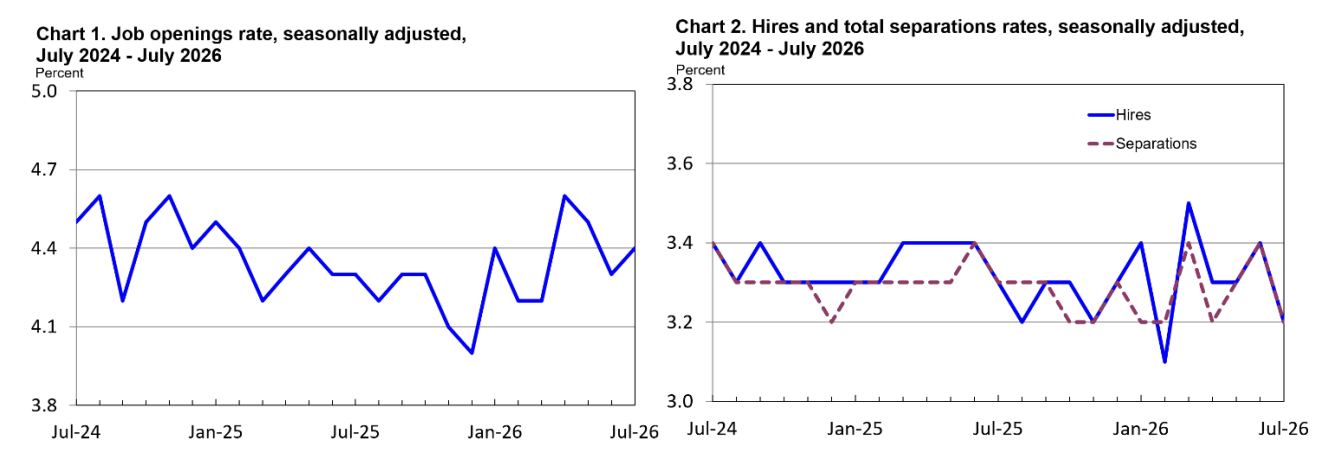
The Job Openings and Labor Turnover Survey (JOLTS) for July, released by the BLS on 1 September 2026, gives a similar picture. Job openings stood at 7.27 million, up from a revised 7.18 million in June, while the job openings rate remained at 4.4 percent. Durable goods manufacturers reported an increase of 76,000 vacancies.
Hiring remained the weaker part of the report. Total hires stood at about 5.1 million, with the hiring rate at 3.2 percent of total employment. Professional and business services recorded 188,000 fewer hires. However, there was little evidence of a sharp rise in labour stress. Quits held close to 3.1 million, with the quit rate at 1.9 percent, while layoffs and discharges were about 1.7 million at a rate of 1 percent.
Taken together, JOLTS and the August payroll report suggest that the labour market has become less dynamic but remains stable. Employers are hiring more cautiously than during earlier periods, but businesses are not responding with broad layoffs.
Manufacturing Expansion Comes with Persistent Price Pressure
Manufacturing provides another reason for the Fed to remain focused on inflation. The Institute for Supply Management (ISM) Manufacturing Purchasing Managers’ Index (PMI) registered 54.6 in August, down from 55.6 in July but marking an eighth consecutive month of manufacturing expansion. A PMI reading above 50 generally indicates that more manufacturers are reporting improving rather than deteriorating business conditions.
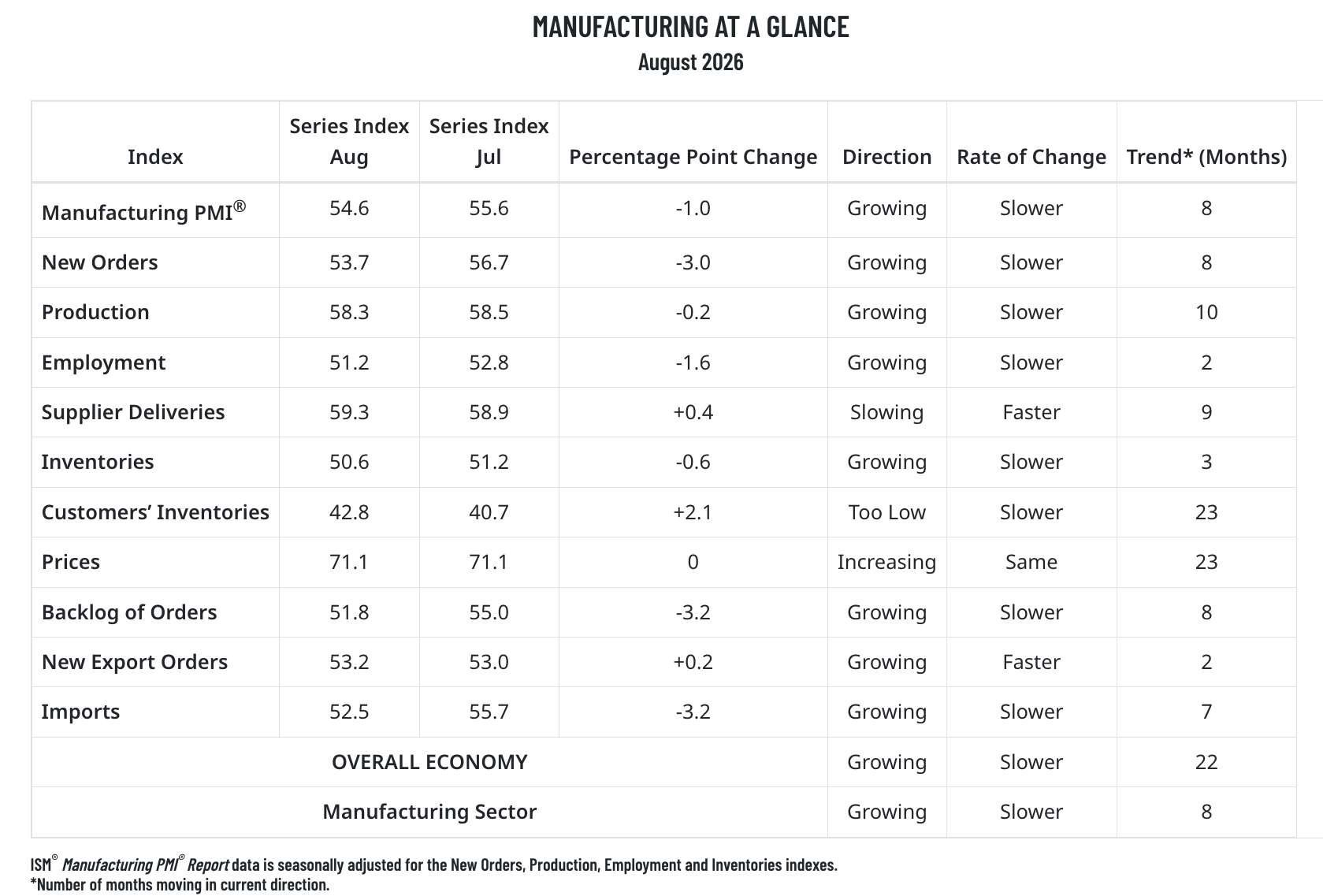
Demand and production also remained in expansion mode. The New Orders Index stood at 53.7, while the Production Index registered 58.3. Customers’ inventories remained low at 42.8, which can support future production because customers may need to rebuild stocks. Government orders and demand related to AI infrastructure were among the areas highlighted by manufacturers.
The more difficult signal came from costs. The Prices Index remained at 71.1 for a second month, marking a 23rd consecutive month of rising raw material prices. Supply conditions also remain challenging. Supplier deliveries slowed further, while 58 percent of manufacturer comments were negative compared with 42 percent that were positive. Pricing volatility appeared in 57 percent of the negative comments, while businesses also cited longer lead times, tariffs and the conflict in the Middle East. These pressures show how supply shocks can keep inflation elevated even when domestic wage growth is moderating.
The Fed Has Less Reason to Focus on Employment
The latest data shift the balance of the Fed’s dual mandate of maintaining maximum employment while restoring price stability. August labour data suggest employment is not currently under severe pressure, though inflation remains above the Fed’s 2 percent target.
This makes a 25 basis-point increase at the September meeting easier to justify. However, the decision is not settled. The BLS will release the August Producer Price Index (PPI) on 10 September 2026, followed by the Consumer Price Index (CPI) on 11 September 2026. The PPI tracks prices received by producers, while the CPI measures changes in prices paid by households. Weak readings from both reports could strengthen the argument for leaving interest rates unchanged. Stronger inflation readings would add to the case for tighter policy.
The central question is no longer whether the US labour market requires immediate policy support, but whether inflation remains persistent enough to justify reversing part of the 75 basis points of rate cuts delivered in 2025.
For now, the combined evidence from employment, job openings and manufacturing tilts the policy debate towards a 25 basis-point increase. The labour market has cooled, but is not under stress. Manufacturing continues to expand, however, as producers continue to report significant cost pressure. Unless the upcoming inflation reports show a clear reduction in those pressures, the Fed has more room to prioritise price stability at its September meeting.

The September Meeting is Being Priced One Release at a Time
Markets have repeatedly repriced the 16 September Fed decision over the past two weeks, as reflected in the short-end of the yield curve. The long end has proved to be not so sensitive. Expectations for a 25 basis-point increase swung short-term yields sharply around Fed Chairman Kevin Warsh’s Jackson Hole speech, Fed Governor Christopher Waller’s comments and the August payroll report that followed. Yet the 30-year Treasury yield remained near recent highs. The front end is trading the Fed. The long end is trading supply.
Three Catalysts, One Meeting
Chair Warsh set the first move on 28 August by making the 2 percent target a hard constraint and refusing to give guidance, as Bitfinex Alpha issue 220 set out. The market took the probability of an increase to 57 percent and then, over the following two days, to about 66 percent, according to CME FedWatch data. This was despite no new economic reports to support such a move, suggesting the repricing was driven more by Warsh’s remarks than fresh data. Fed Governor Christopher Waller then contributed to a reversal of expectations. Speaking at a Reuters event in Washington on 3 September, he said he was willing to support holding the policy rate if progress towards the 2 percent goal continued, asking the market to “give disinflation a chance.” He added that only a hot inflation reading would make him consider an increase. Waller also described the current 3.5-3.75 percent range as only slightly restrictive. This dragged the probability of a rate hike back to 49 percent and the two-year yield dropped five basis points to 4.34 percent, exactly where it had closed after the Jackson Hole speech.
The August payroll report however reversed this sentiment just one day later. Nonfarm payrolls rose by 162,000 against a consensus near 56,000. The probability of a rate increase returned to 60 percent and the two-year closed at 4.37 percent, three basis points higher on the day.
Each of these moves is consistent with the views expressed in Bitfinex Alpha issue 220, which argued that the rate decision turned on the two data releases still to come. The pricing has behaved accordingly: it rose on a speech, fell on a speech and rose on data. A committee that will not pre-commit has also handed the meeting to the calendar, with one more important release to come. The August Consumer Price Index (CPI) lands on 11 September. Waller’s condition for holding — continued progress on inflation — now appears to be the clearest remaining path to a hold.
Fed Rate Repricing Reflected in the Front End
Given the daily swings in the past two weeks, the scale of the front-end move is easy to underestimate.
From the 27 August close to the 4 September close, the two-year yield rose 17 basis points, from 4.20 percent to 4.37 percent. The five-year rose 16 basis points, from 4.38 percent to 4.54 percent. In contrast, the 10-year rose 11 basis points to 4.78 percent and the 30-year rose five basis points to 5.24 percent.
The short end and the long end are measuring different risks. A two-year yield is mostly a bet on where the policy rate will be over the next two years. A shift from expecting a hold to expecting an increase moves the two-year with it. A 30-year yield is mostly compensation for holding government debt for three decades. The size of that compensation depends on how much long-dated debt the Treasury has to sell. A single policy meeting has little bearing on it.
The long-end term premium has been building since the spring, mainly due to fiscal concerns. With the US deficit reaching $1.8 trillion in the first 10 months of the US fiscal year, the Treasury has said it will keep coupon auction sizes unchanged for several quarters and investors have demanded a higher yield to absorb that supply. The 30-year reached its 5.31 percent high on 17 August, before Fed Chairman Kevin Warsh’s hawkish turn at Jackson Hole and without any corresponding change in rate expectations. It has had little reason to move since, with nothing in the past week materially changing the outlook for long-dated supply.
With the two-year rising on policy rate expectations, while the 30-year remains elevated but relatively stable, a flatter yield curve at the long end reflects tighter financial conditions than the policy rate alone implies. It raises the cost of short-term borrowing without giving the long end any relief.
The 10-year real yield on Treasury Inflation-Protected Securities (TIPS) closed at 2.43 percent on 4 September, just one basis point above the 2.42 percent it closed at after the Jackson Hole speech.
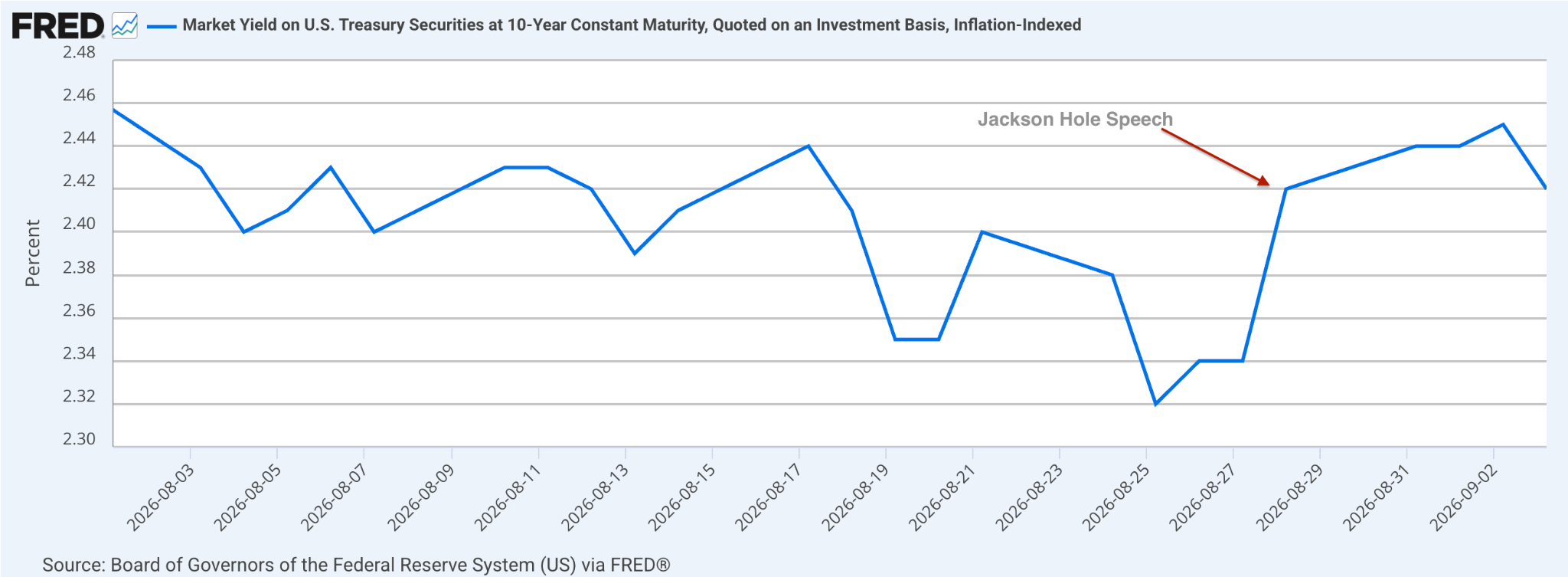

After the Jackson Hole speech last week, we argued that the September rate decision would be settled by the two remaining data releases: the August jobs report and the August inflation report. The first of those has now arrived and changed our view to a 25 basis-point increase now being the more likely outcome.
In last week’s Bitfinex Alpha, we set a simple test for the expectation of a hold: if the market’s probability of a September increase rose above 60 percent and stayed there, the hold call would be wrong. That probability did cross 60 percent, twice, but it failed to stay there. It reached about 66 percent on 31 August and dropped to 49 percent on 3 September after Fed Governor Waller said he would be inclined to hold in current circumstances, only to return to 60 percent the next morning on the payroll data. As of 7 September, the probability of a rate hike sits at 58.4 percent. A market that swings 17 percentage points on one comment and then swings back on one report reflects continued uncertainty on rates. That part of our reading holds.
What has changed is our reasoning for expecting a hold in the first place. Our case rested on the labour market. With hiring stalling, July payrolls initially reported as falling and real consumer spending close to flat, we argued that the Fed had little room to raise rates without risking jobs.
Last week’s August report removed that argument after payrolls rose by 162,000, with July data revised from an initially reported loss of 23,000 jobs, to a gain of 21,000, with unemployment rate stable at 4.1 percent. A labour market that continues to add jobs at that pace can absorb a quarter-point increase. The data removed any need for constraint on rates, and with it the case for a hold.
Wednesday’s Buyback is the Long End’s Test
In the coming week, the long end will get its own test. On 9 September, the Treasury will run the first liquidity support buyback at the enlarged size announced by Treasury Secretary Scott Bessent on 19 August. This will see a doubling of operations in the 10-to-20-year and 20-to-30-year sectors from $2 billion to at least $4 billion until 4 November. The Treasury justified the change by citing “consistent strong sponsorship from market participants” and “the volume of high-quality offers” it says it routinely receives in those sectors. This makes Wednesday’s operation test both that claim and the market.
If rates increase on 16 September while the 30-year yield remains below 5.31 percent, it would confirm that the long-end premium is fiscal and that the Fed can raise the policy rate without raising the government’s long-term borrowing cost. If rates increase and the 30-year yield keeps rising despite the added Treasury buying, this will suggest that the premium is outrunning liquidity support and July’s pattern whereby the long end sold off on supply and pulled risk assets down with it.
If, however, rates are held following a soft CPI print, we would expect the front end to unwind while leaving the long end unchanged. The order of events is fixed: the buyback on 9 September, the PPI on 10 September, the CPI on 11 September and the decision on 16 September.

Why This Matters for Crypto
The Battle Between Flows and Rates
In Bitfinex Alpha issue 220, we set out a test for the week: whether US spot bitcoin ETF inflows inflows and the stablecoin market cap could both rise for a full week, even while the market priced a September increase above 50 percent. Both measures largely held up.
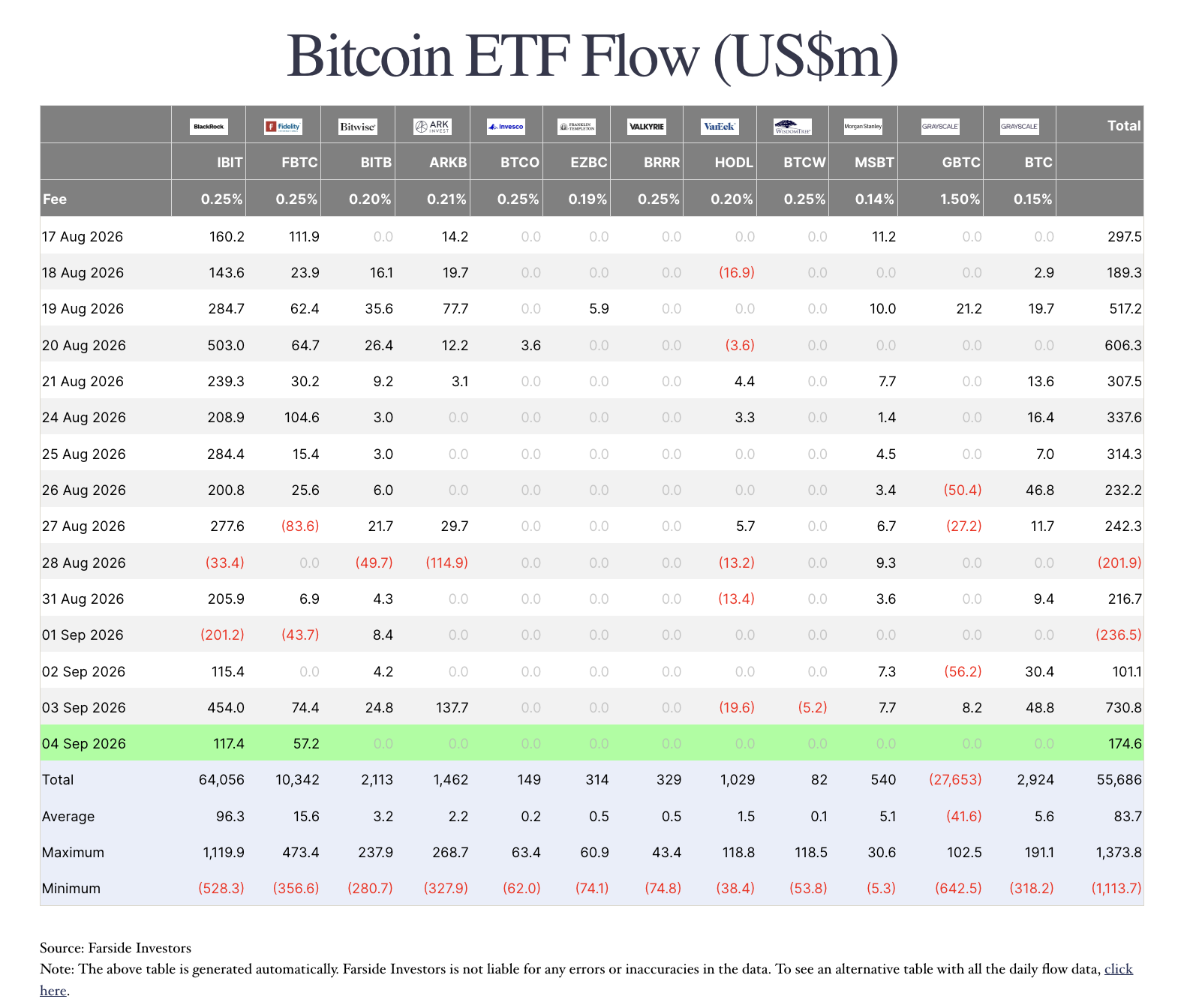
Bitcoin spot ETFs took in $986.7 million across the five sessions from 31 August to 4 September. There were $216.7 million of inflows on Monday, an outflow of $236.5 million on Tuesday, then $101.1 million on Wednesday and $730.8 million on Thursday, the largest single session since January, followed by a further $174.6 million on Friday after the payroll report. The stablecoin market cap rose about $1.26 billion over seven days to $305.26 billion as of 4 September.
Price told a different story. BTC traded above $81,000 into the 4 September release and fell below $80,000 within minutes of it, the second time in a week that a hawkish catalyst has turned it back from the top of the range.
This confluence of factors is currently one of the key determinants of price. While liquidity in the market provides a floor, the short-end of the Treasury curve sets the ceiling.
The marker for this week is whether ETF inflows stay positive through the 9 September buyback and the 11 September CPI, even while the two-year holds above 4.34 percent. A market that continues to buy even as the front end of the yield curve remains high, will be an indication that it no longer treats the policy rate as the binding constraint.
What Would Prove This Wrong
Our view going into the meeting has three parts. First, the Fed is now more likely to raise rates by 25 basis points than to hold. Second, the high yields on long-dated Treasuries reflect the volume of debt the government has to sell, not fears of runaway inflation. Third, the money flowing into cryptocurrency through spot bitcoin ETFs and stablecoins is putting a floor under prices, while rising short-term yields are putting a ceiling on them.
Of the tests we set last week, one has already been answered. A weak jobs report would have kept the Fed on hold. The report was strong and that is why the first part of our view changed. The remaining tests went untriggered: the 30-year yield closed at 5.24 percent, below its 5.31 percent high. The 10-year real yield stayed at 2.43 percent, under the 2.5 percent level that starts to hurt non-yielding assets. Jobless claims stayed low at 206,000, while crypto inflows continued.
The following are the conditions that would prove the current view wrong:
The August inflation report on 11 September shows core prices rising 0.2 percent or less on the month and the market’s probability of a September increase drops below 40 percent and stays there. Governor Waller has said a soft inflation reading is his condition for holding, which makes this the clearest route back to a hold.
The two-year Treasury yield closes below 4.2 percent, where it stood before the Jackson Hole speech. That would mean the market has fully unwound its bet on a rate increase.
The 30-year yield rises above its 5.31 percent high while the Treasury is buying back long-dated bonds, or the first enlarged $4 billion buyback, executed on 9 September, attracts weak demand. Either would mean the supply problem in long-dated debt is worsening faster than the Treasury can manage it.
The 10-year real yield holds above 2.5 percent for two straight weeks. At that level, inflation-protected bonds start to compete seriously with assets that pay no yield.
Weekly jobless claims rise above 230,000 for two weeks running, which would reopen the case that the labour market needs protecting.
Spot bitcoin ETFs record a full week of net outflows, while the stablecoin supply shrinks. That would mean last week’s $986.7 million of inflows represented capital rotating within cryptocurrency markets, rather than new money coming in.
BTC closes a week above the $82,100 top of its range, while the market still prices a rate increase above 60 percent. That would mean higher short-term yields have stopped capping prices and the crypto outlook is stronger than the current view allows.
