

Bitcoin Eyes $84,400 as ETF Demand Returns
Bitcoin has continued to defend the range lows despite repeated attempts to break lower. We expect it to trade between $81,300 and $84,400 ahead of the 28 October Federal Open Market Committee (FOMC) rate decision. Initial tests of the upper boundary may, however, encounter selling pressure as short-term traders take profits.
Recent market metrics highlight three main dynamics: sustained spot demand via Exchange Traded Funds (ETFs), an upwards shift in cost-basis distribution and rebuilt leveraged exposure.
Monday’s (19 October) net ETF inflows of $526.7 million marked a notable increase in spot demand, yet prices remained tightly range-bound between $81,724 and $83,470, supported by consistent dip-buying. The current consolidation structure, however, sits below the average ETF cohort cost basis of $84,333.
Derivatives and Positioning Metrics Show Normalisation
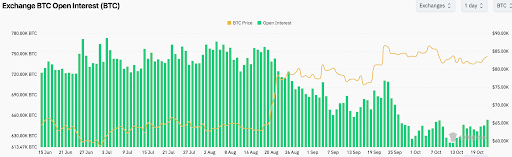
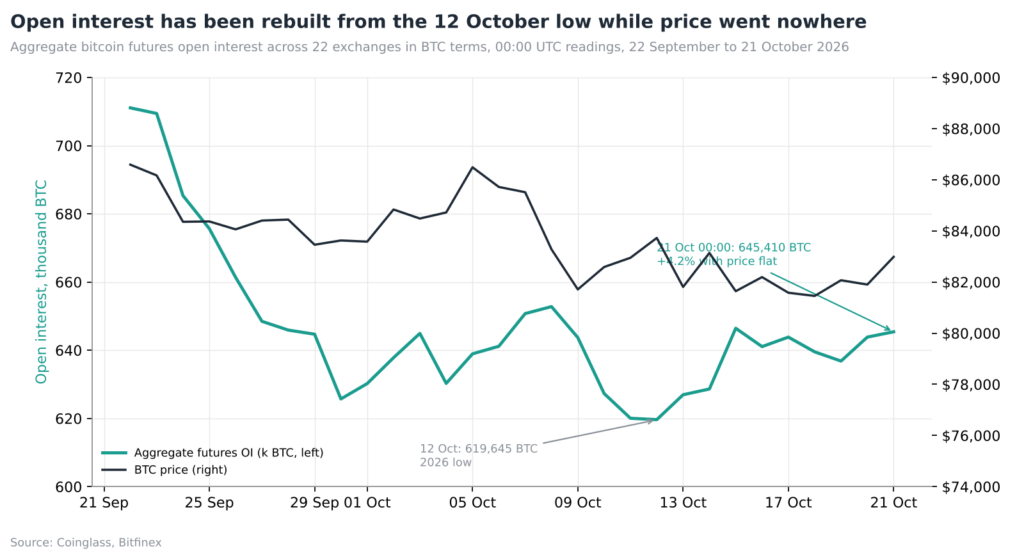
Futures open interest (OI) across key exchanges had risen 4.2 percent to 645,410 BTC by 20 October from its recent low on 12 October. This increase is consistent with new long positioning rather than a broader structural shift. Funding rates have normalised to annualised levels of seven to nine percent during peak sessions, indicating a moderate leveraged long bias in the short term. This dynamic has historically proved sustainable in healthy bitcoin uptrends.
Institutional participation via Chicago Mercantile Exchange (CME) OI remains stable at approximately 112,000 BTC (roughly 17.4 percent of total OI), indicating steady institutional exposure without aggressive expansion or contraction.
Options Markets Are Hedging and Positioning Defensively
The Friday, 23 October options expiry carries $1.23 billion in notional OI with a maximum pain price near $82,000. Implied volatility suggests a narrow expected price range of $80,750 to $84,650 into the weekend with positive gamma currently active on either side of the range. This implies that option sellers and dealers would be selling into price expansions beyond the range high and buying on breaches of the range low.
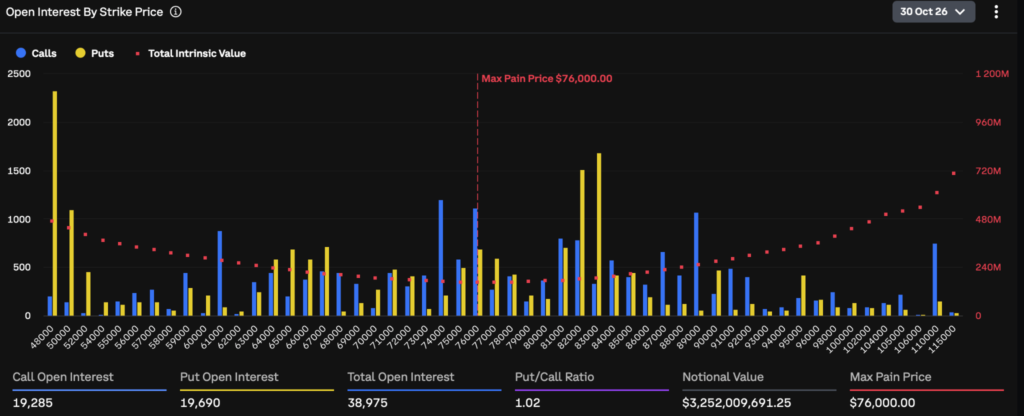
Chart 3: Deribit open interest by strike for the 30 October expiry, puts and calls, with the implied one-standard-deviation range ($78,300 to $87,100) Source: Deribit Metrics

The monthly expiry on 30 October represents $11.2 billion in notional value across all platforms, with maximum pain centered at $76,000. The implied one-standard-deviation range spans $78,300 to $87,100, reflecting hedging activity against potential volatility around the FOMC announcement on 28 October.
On-Chain Supply Cost Basis Continues To Drift To Higher Prices
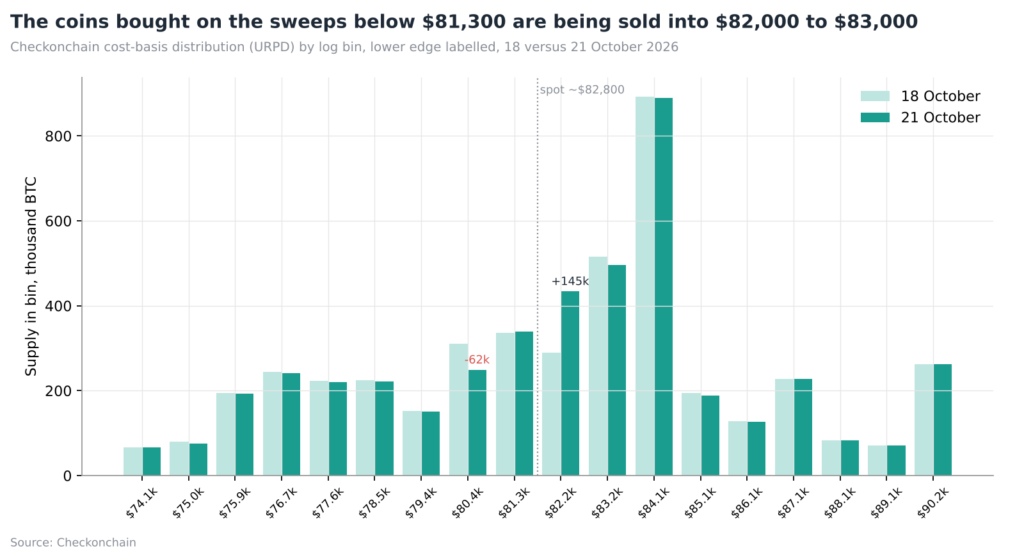
On-chain distribution data shows supply moving to higher cost-basis levels. The $80,353 cost-basis bin shed 62,000 BTC, while the $82,224 bin added 145,000 BTC. This indicates that coins acquired during recent price dips below $81,300 are shifting into higher support clusters between $82,200 and $83,200.
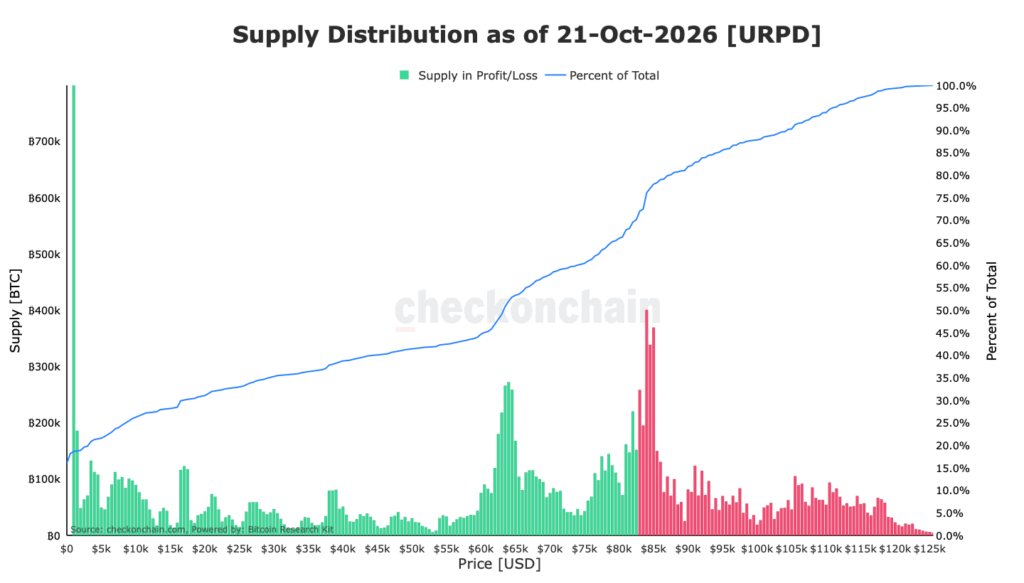
Short-Term Holder Spent Output Profit Ratio (STH-SOPR) stands near 1.003, signaling modest profit realisation among recent buyers. Supply in profit sits at 70 percent, relative to the long-term baseline of 75 percent. This behaviour typically signals bull market uptrends that sustain for extended periods of time.
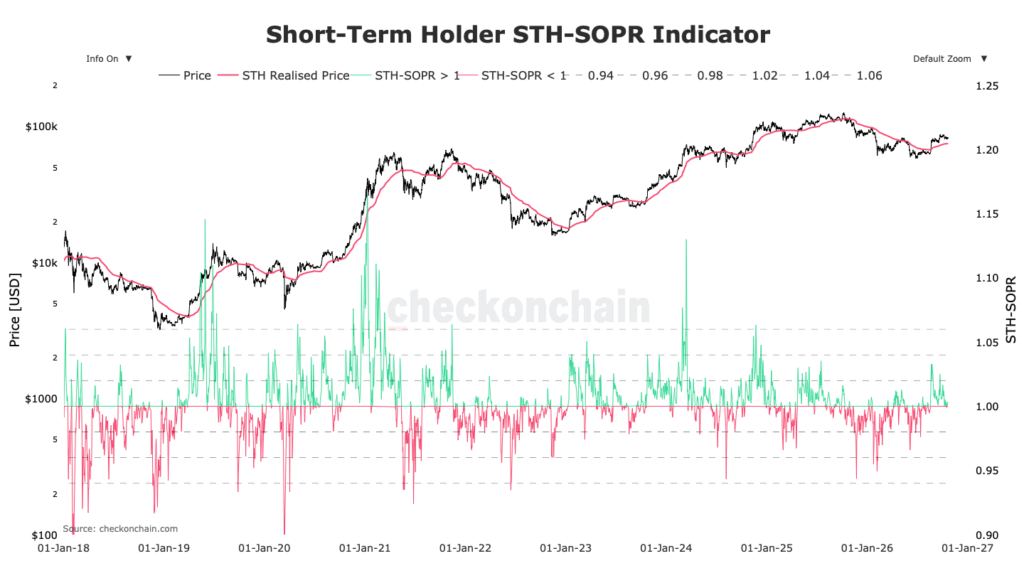
Chart 5: STH-SOPR with the 1 line, Comparisons Between Different Regimes Of STH profitability fluctuations. Source: Checkonchain.
Institutional Flows and Macro Drivers
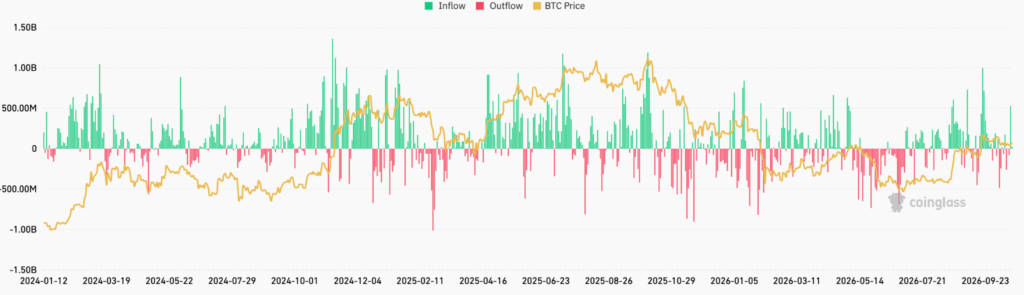
Net ETF inflows reached $526.7 million on 19 October, led by BlackRock’s IBIT at $665.2 million, followed by $23.2 million on 20 October. Consecutive sessions of institutional inflows remain the key condition for a break above $84,000 resistance.
On the macroeconomic front, equity market trends — particularly within tech and AI-focused sectors — continue to show a notable correlation with digital asset prices. Upcoming quarterly earnings reports and inflation metrics will provide further context for broader risk sentiment ahead of the Fed’s policy update on 28 October.
| Date (UTC) | Event | Why it matters |
|---|---|---|
| 21 Oct, after 20:00 | Meta, Tesla, IBM, Lam Research, Texas Instruments earnings | AI capital-spending guidance sets whether the Nasdaq selloff resumes; bitcoin’s 20-day Nasdaq-100 correlation is 0.78 |
| 22 Oct, 12:30 | US initial jobless claims | Only labour reading before the FOMC |
| 23 Oct, 08:00 | Options expiry, $1.23 billion | 1.09 puts per call, maximum pain $82,000; implied range $80,750 to $84,650 |
| 28 Oct, 18:00 | FOMC decision, press conference 18:30 | 84 percent priced for a hold; statement language on December is the risk; decision-day returns have averaged minus 1.2 percent after a rally into the meeting |
| 29 Oct, 12:30 | US third-quarter GDP and September PCE | GDP below three percent would move the December debate from one hike to none, as set out in the weekly |
| 30 Oct, 08:00 | Options expiry, $11.2 billion | 0.57 puts per call, maximum pain $78,000, calls stacked at $90,000 to $100,000 |
Levels to Watch and What We Want to See at Each One
| Level | What it is | What we want to see |
|---|---|---|
| $84,400 | ETF cohort cost basis ($84,333); above it supply in profit reclaims 75 percent | A daily close above it on a day with a second ETF inflow above $300 million, with funding falling towards three percent and open interest flat; a close above it with funding near nine percent is a leveraged move and will be sold |
| $83,470 | Tuesday, 20 October high; the first higher high since 12 October | Price holding above it through Friday’s options settlement, which would make $83,200 to $84,100 the next absorption zone (the $83,176 bin holds 496,000 BTC) |
| $82,200 to $83,200 | Where 145,000 BTC changed hands this week; the new centre of the range | Dips into it bought on the same day; STH-SOPR staying at or above 1.0 |
| $81,300 | Former range high; traded below in five of the last six sessions, never on a closing basis | A sixth sweep bought in-session; a daily close below it with an ETF outflow above $200 million and STH-SOPR below 1.0 is the view change |
| $79,821 | The 15 October low and the weekly’s trigger for the $77,600 to $80,400 band | If reached before the FOMC decision on 28 October, a low on falling open interest and long liquidations (a flush) rather than rising open interest (a trend); the band still holds 842,000 BTC |
| $77,569 | True Market Mean; the $77,000 cost basis of the new-whale cohort sits beside it | No daily close below it; a close below exposes $76,000 and the $74,613 short-term holder cost basis |
Expectations For The Week Ahead
Our baseline expectation is for bitcoin to maintain its primary range between $81,300 and $84,400 heading into the 28 October FOMC meeting. Sustained ETF demand with stable leverage metrics would support a breakout above $84,400, while macro headwinds combined with a close below $81,300 would increase the risk of a move towards the 15 October low at $79,821.
| Path | What activates it | What has to confirm it | Where it goes |
|---|---|---|---|
| Spot-led push above $84,400 | A second ETF inflow above $300 million this week; AI earnings guidance steadies the Nasdaq | Daily close above $84,400 with funding under five percent and open interest flat; supply in profit above 75 percent; STH-SOPR above 1.0 | $84,100 to $86,100 (1.08 million BTC held at a loss), then $87,197 |
| Range into the FOMC (base case) | ETF flows between minus $150 million and plus $300 million; equities hold Monday’s rebound | Dips to $81,300 bought in-session; funding easing from nine percent; pinning near the $82,000 maximum pain into Friday | $81,300 to $84,400 into 28 October; FOMC-day return skewed negative if price has rallied into it |
| Leveraged flush Before the FOMC | AI earnings reopen the equity selloff; an ETF outflow above $200 million | Daily close below $81,300; long liquidations dominant with open interest falling; STH-SOPR below 1.0 for consecutive days | $79,821, then the $77,600 to $80,400 band (842,000 BTC), with $77,569 the level that changes the view |
Three readings will determine which path the market is on by Friday’s options settlement.
The first is ETF flows on Wednesday and Thursday: Monday’s inflow needs a second session of similar size to confirm demand. The second is the open-interest-weighted funding rate, because a move to $84,400 on nine percent funding repeats the setup that unwound on 8 and 15 October. The third is the $80,353 and $82,224 cost-basis bins. The hand-off from dip buyers to new buyers is what raises the floor without lifting the ceiling.